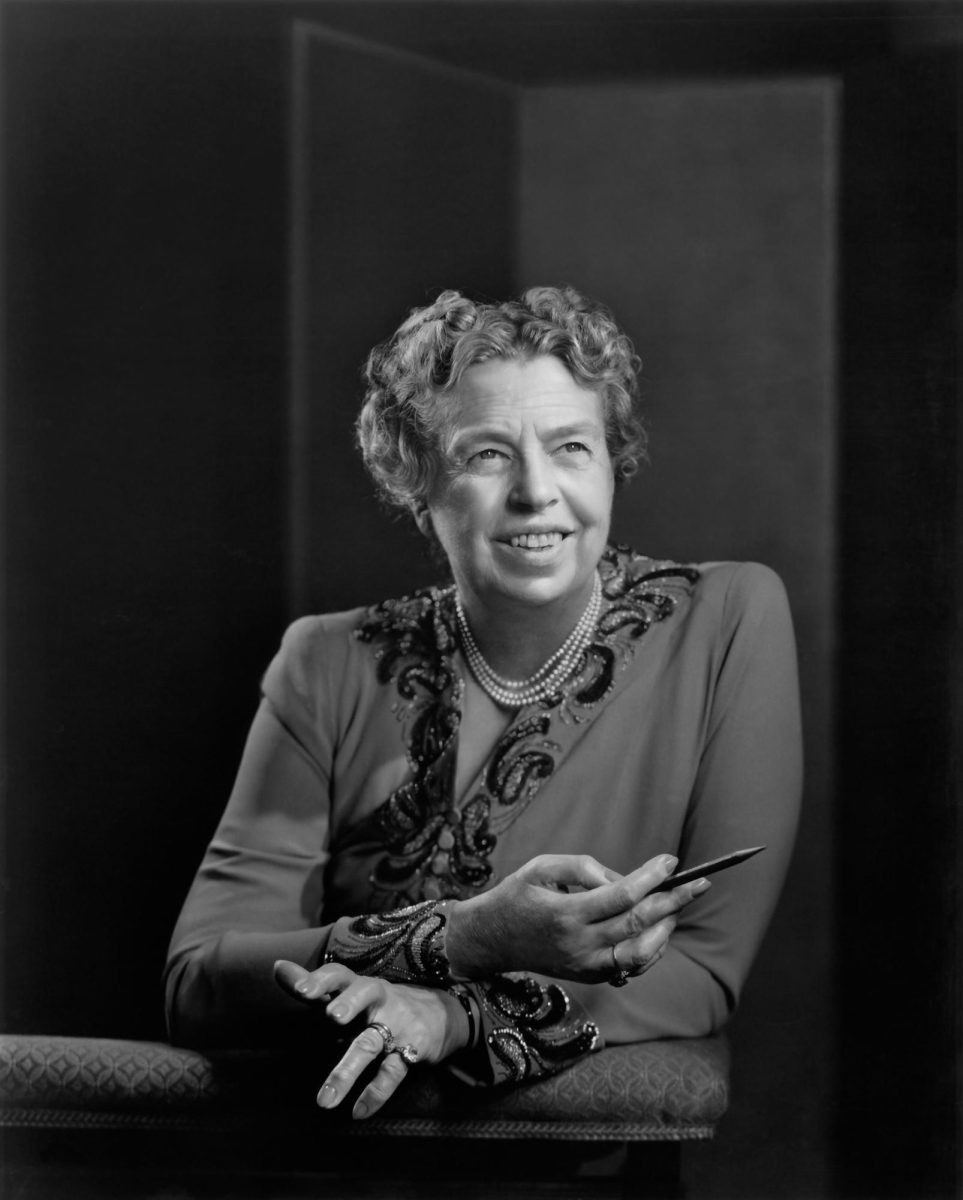
Eleanor Roosevelt, the beloved wife of Franklin. D. Roosevelt was the longest serving first lady of the United States. She served through her husbands 4 year term from 1933 to 1945. Not only is she known to be the longest serving first lady, but also for being a human rights activist, and diplomat who redefined her role through active public service, advocating for civil and women’s rights. She transformed her role of First Lady into a powerhouse of political activism, advocating for the rights of everyone who needed a voice.
Anna Eleanor Roosevelt was born on October 11, 1884, and was born in Manhattan, New York City. Her parents were socialites named Anna Rebecca Hall and Elliot Roosevelt. She always preferred to be called by her middle name. She was the niece of Former President Theodore Roosevelt through her father.
When she was just 8 years old, her mother and one of her brothers passed away from diphtheria. And then, when she was nearly ten her father died from a seizure. She, and her younger brother Hall were the only ones left. She went to go live with her maternal grandmother after her parents passed away. She promised before her father died that she would act as his mother towards him. While he was enrolled in school, she would write him daily, but always regretted that he didn’t have a more stable childhood.
She was sent to Allenswood Academy in Wimbledon, London, for education at the age of 15. She was loved by everyone at her academy and wanted to continue there, but was summoned back home by her grandmother to make a social debut.
In the summer of 1902, she met her fifth cousin, and future husband: Franklin Delano Roosevelt. They started to secretly correspond to each other and later got engaged and married in the spring of 1905.
They had six children together, even though Eleanor never considered herself to be able to understand young children. In 1911, Franklin was elected to the New York State Senate, and the family moved to Albany. And two years later, they moved to Washington DC, and then Franklin joined Woodrow Wilson’s administration and was the Assistant Secretary of the Navy. Soon after, when WW1 happened, Eleanor started to get involved in various relief agencies.
In September 1918, it was discovered that Franklin Roosevelt was having an affair with a woman named Lucy Mercer. And Rooselvet was considering leaving Eleanor, but eventually decided against it. This led to a shattering in their relationship, and their marriage seemed to be a mere partnership after that. After this occurrence, she became more independent and often went to her upstate NY home, but still remained a supportive figure, especially politically.
“There was a time when a woman married and her property became her husband’s, her earnings were her husband’s, and the control of the children was never in her hands. The battle for the individual rights of women is one of long standing, and none of us should countenance anything that undermines it.”
-“My Day,” August 7, 1941
1920 was the year that Eleanor really started to advocate for women’s rights and suffrage. She started to surround herself with influential, politically intelligent women who shared the same wants as her. She did this, though, having leadership roles in many organizations, which included the League of Women Voters and the Women’s Trade Union League. Her activeness in the movement made her widely covered in the media, and it made her more publicly recognizable than her husband
When in the White House, from 1933 to 1945, the First Lady had a very active schedule. She spent her time writing nearly 3,000 articles for newspapers and magazines, which included a monthly column in the Women’s Home Companion, where she used her articles to ask the public about their stories and their questions. She received over a hundred thousand responses from the public and donated her earnings from the article to charity.
First Lady Roosevelt had a huge impact on her husband’s presidential decisions, including his cabinet and details of the New Deal. During her time in the White House, she influenced her husband to appoint more women, which led to Frances Perkins being the first woman to head the Department of Labor. She also supported the Civil Rights movement, though advocating for the NAACP and fighting for anti-lynching laws and much more.
Even after her husband died, she continued her political activism. In 1946, she was appointed to the United Nations and served for more than a decade. She also helped write the United Nations Declaration of Human Rights in 1948. She was nominated for the Nobel Peace Prize by John F. Kennedy, and although she did not win, she still remains at the top of national polls, which ranked the most respected women in America many years after her death.
“In politics, I have never felt that anything really mattered but the satisfaction of knowing that you stood for the things in which you believed, and had done the best you could.”
-“My Day,” November 8, 1944
First Lady Roosevelt’s legacy lives on throughout the present day because of her foundational role in advocating for women’s and civil rights as well as social justice. Her advocacy had a lasting impact on the country, leading her to be remembered as the redefining First Lady, as she used her role for political activism and public service. She is counted as one of the most well-known and loved women in history who shaped how our world is today for the better.