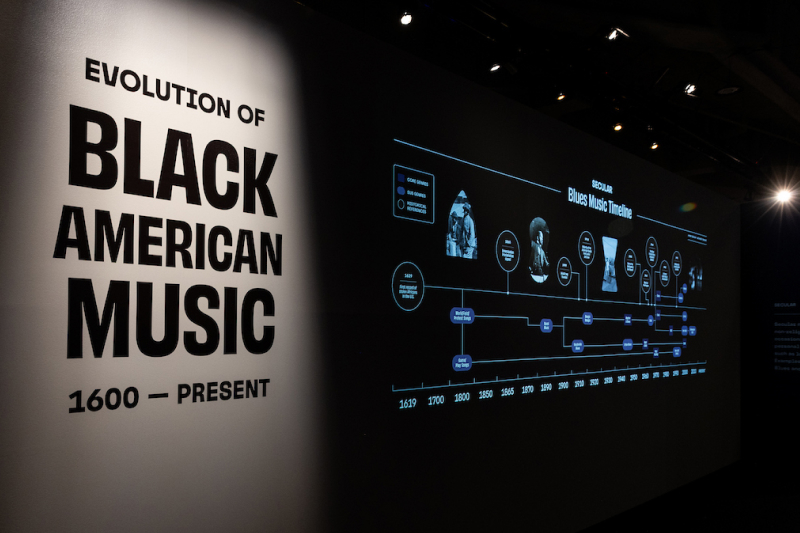
In honor and appreciation of Black History Month, here’s a breakdown of the evolution that led us to the integration of genres invented and popularized with the work and creativity of black artists into the music we listen to now.
Music by black musicians emerged in the 19th century, where work songs were sung by enslaved people as a way to motivate each other and protest the system.
Post Civil War is when the Blues emerged from the Mississippi Delta, formed not just for communication, but for entertainment as well. Rock and roll was later influenced by this genre through artists like Elvis Presley and The Rolling Stones, but it was also used for the history of country music.
Gospel music began to rise during that period, also helping shape the soul and R&B sound carried by artists such as Aretha Franklin. Jazz was introduced later, and pioneers for this genre, like Louis Armstrong and Miles Davis, brought new ideas around rhythm as well as improvisation into their art.
Both classical and popular music were influenced with this genre’s rise and changed quite a lot. By the 70s, hip-hop took root in The Bronx, blending spoken word, DJ-ing, and sampling into a new form that would go on to influence pop, electronic, and global music scenes. Speaking of the 70’s , the Black Music association was launched by Kenny Gamble (Producer), Dyana Williams ( influential music activist and broadcaster), and Ed Wright (Broadcast Executive).
The first gathering was also hosted by Jimmy Carter in the summer of 1979, and he later signed a Presidential Proclamation giving African-American Music Appreciation Month national designation in the year 2000.
The challenges faced in the proccess of integration that were previously mentioned in my introduction were things such as under-representation, economic exploitation, unequal pay, exclusion and tokenization, lack of control with contracts and music ownership , and mental health burdens, as well as so many other things.
There was also a heavy lack of opportunities, fair compensation, and the ability to secure record deals. Biased hiring practices, unequal access to resources, and limited support for artists from marginalized communities were also obstacles faced throughout the journey to success for black artists. But people managed to persevere and pushed for change since music had such a special ability to access any space, even ones that were separated. Music has also always been used to advocate and as an honest recount of struggles faced by the black community.
After being discriminated against for so long , there have been so many special milestones for black artists and special people who were trailblazers such as:
Louis Armstrong who revolutionized jazz.
Florence Price who was the first black woman recognized as a symphonic composer.
Nina Simone who merged jazz, blues, and classical while championing civil rights.
Stevie Wonder who was a child prodigy, multi-instrumentalist, and winner of 25 Grammy Awards.
Bob Marley who popularized reggae.
Tina Turner who broke barriers in the ’80s and was considered the queen of rock and roll.
Henry Belafonte who was the first black Emmy Award winner.
The struggle and time it took for black artists to be appreciated was something I see as extremely difficult, but it came with worthy results. With the rapid growth of genres created by black artists being shown in charts, evolving into newer genres, or being blended into modern pop music today.